Tone bender 
Schematic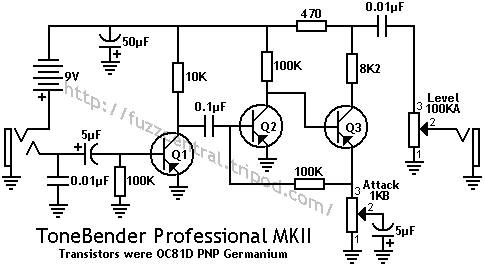
Passives
Actives
Box
Potentiometers
100K Log Audio Taper
1k Linear Taper
Audio Jacks
https://store.generalguitargadgets.com/products/colorsound%E2%84%A2-tonebender%E2%84%A2-mark-ii-professional-replica-rts-pcb
This
is probably one of the most legendary fuzz pedals that has ever
existed, and for good reason too! This thing can produce some completely
saturated fuzz that is capable of slipping into feedback easily if you
crank it up loud enough. I just can't say enough about this pedal. This
is, without a doubt, my all-time favorite fuzzer. It's a genuine kick in
the teeth that will have a permanent spot in my setup. Supposedely,
this is the fuzz pedal that Jimmy Page used on the first couple of Led
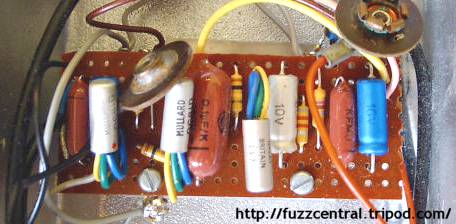
Zeppelin albums, which makes it even more famous. Below is a picture of
the circuit board in a ToneBender MKII. Note the silver Mullard OC81D
transistors:
There
are a lot of schematics on the internet that don't have the 0.01�F
capacitor on the input jack side of the input capacitor, but in the
original ToneBender MKIIs, there was one there. This capacitor helps to
get rid of some of the intense treble that this circuit has without it. I
would recommend that you replace the 8K2 resistor on the collector of
Q3 with a 20K trimpot which will allow you to adjust Q3s collector
voltage to -4.5VDC. I would also add a pulldown resistor to the input of
the circuit and a reverse polarity protection diode to help protect
those expensive Germanium transistors. Another nice tweak is to replace
the 470-ohm resistor in the original circuit with a 1K or 1K2, which
will boost the available output quite a bit. The original OC81D
transistors will be very hard to find...and very expensive if you do
find them. In all reality, they aren't any better sounding than other
types, such as OC44, OC75, 2N404, 2N508, 2N527, etc. The transistor
gains for the MKII should be something like 70 for Q1 and Q2 and 100 for
Q3. The gains don't have to be exact, but it helps for them to be close
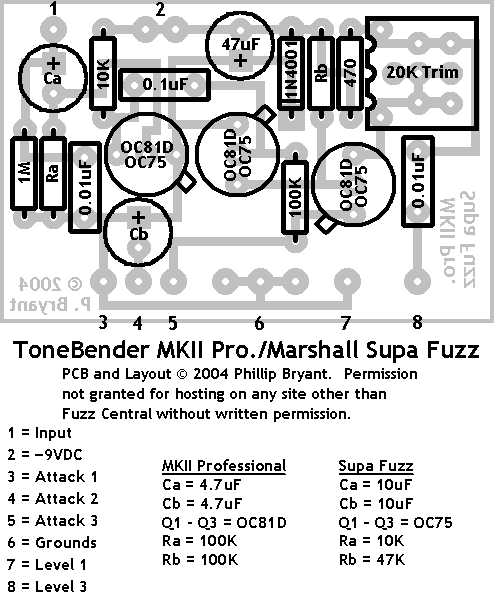
to these values. ***These tweaks are included on the ToneBender MKII
Professional PCB and Layout at the bottom of the page, but they are
optional.***